Saturday, 18 June 2022 Hopkins Day at St Bartholomew’s Church, Haslemere, Surrey


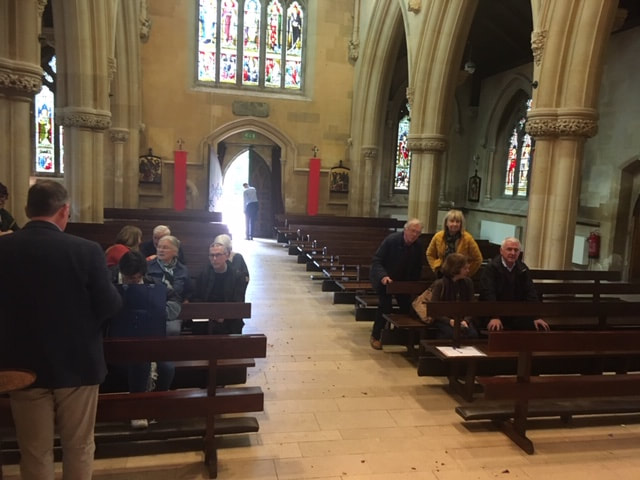
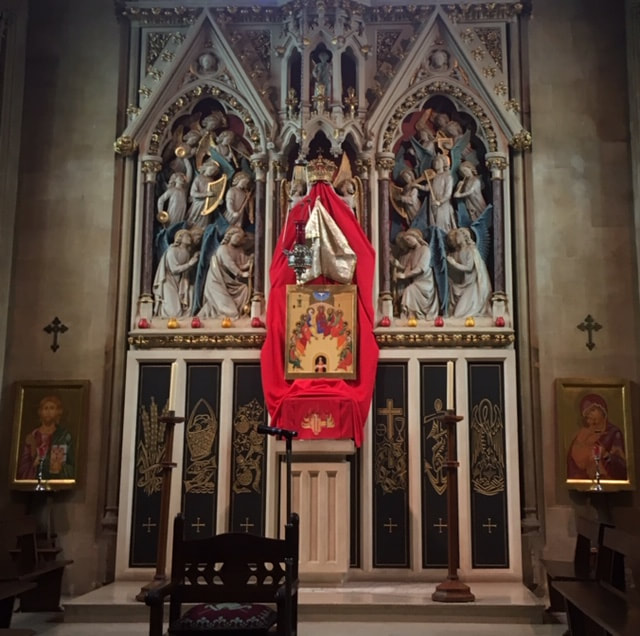
We met in St Bartholomew’s Church in Haslemere, which has a memorial window to Gerard Manley Hopkins donated by his grieving parents less than a year after his death. It was in memory of a dear son – he was not a famous poet then. Rather surprisingly, the stained-glass window next to it is a memorial to the Poet Laureate Tennyson, who had also lived there. Gerard’s parents and family moved to Haslemere from Hampstead three years before he died.

He visited Haslemere only once, but his parents, sisters and brothers lived on in a house built for them, until the last one died in 1952. So there is a long Hopkins family association with Haslemere.

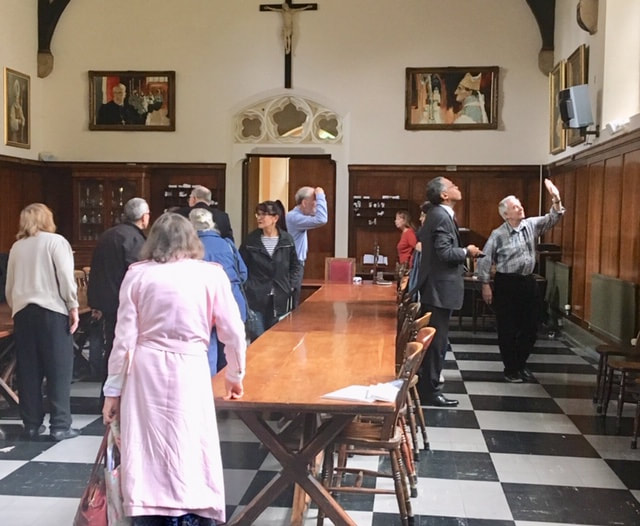
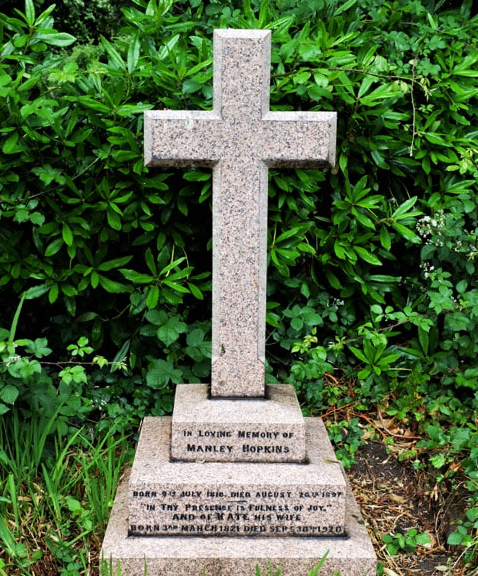
During the visit, we heard about the history and iconography of the GMH memorial window.  We also heard from a local historian about the involvement of the Hopkins family. We visited the family house (at least seeing it from the outside), and saw various family graves. 

The programme for the day:

  • 10.30am Coffee at the Link
  • 11.00am ‘Gerard Manley Hopkins and his family in Haslemere’ – Katherine Jessel
  • 12.15pm ’Suffering and Transformation: the history and iconography of the memorial window’ – Dr Jill Robson
  • 1.15pm Lunch
  • 2.30pm The churchyard and the Garth (viewing)
  • 3.30pm ‘Gerard Manley Hopkins the composer ‘ – Michael Burgess
  • 4.30pm Tea and depart

2021 Highflyers Highgate Conference

2 October 2021. We had originally planned with the Betjeman Society to have The Highgate Highflyers conference in person during the first weekend of October. After consulting the ALS committee, it was held online. 

During that day there were online talks by Lance Pierson on ‘Poetry’s Odd Couple’ by Lance Pierson about the links between Hopkins and Betjeman;  Dr Jane Wright on ‘Making Sense of Hopkins’Poetry’; Dr Jill Robson on ‘Hopkins, Betjeman and Victorian Church Architecture’ and Julia Hudson on the ‘Highgate School Archives of the Two Poets’. At first sight they seem very different poets, but there are many points of intersection between the two in their lives, poetry and interests.

It was a very successful day with excellent sessions by the contributors. Robin Pierson, Lance’s son read Lance’s session as he was not well enough on the day (although he was present via zoom). At the UK Hopkins Society Steering Group meeting on October 28, the President, Michael Burgess paid tribute to Lance’s work with this day as he had spearheaded the whole enterprise from the first meetings in 2019 through to October on behalf of both the Hopkins and Betjeman Societies.

2019 Hopkins and Betjeman Societies at Highgate School

UK Hopkins Society: Sat 31 August 2019  – HAPPIEST DAYS

A joint meeting with the Betjeman Society at Highgate School, London; site of attendance as schoolboys by both poets; Betjeman attending the junior school and Hopkins the senior – both boys fell foul of their Highgate headmasters and a re-enactment was staged of their most fearsome encounters. But was there little positive in their schooldays? We were able to make our own assessment. The school archivist showed us where they did their learning and how the school remembers them today. The Highgate school museum has several artefacts relating to Hopkins on display. We heard what they wrote while at school and what they said about it. We also heard the results of a competition to suggest JB’s most Hopkinesque poem and Hopkins most Betjamanesque!  The day included a tour of the school and the impact of the schools on their poetry. Both were summer babies, and the day finished with a shared celebratory cake.

2019 Hopkins Society Weekend at Belmont Abbey

UK Hopkins Society Weekend at Belmont Abbey 7 – 9 June 2019: “New Worlds”
(from the opening line of Thomas Traherne’s poem “On leaping over the moon” – “I saw new worlds beneath the water lie”).

Hopkins visited the Abbey in June 1866 with William Addis. It was possibly the first time he had met a Catholic priest, Dom Paul Raynal, who ‘was very kind and showed me over everything.’ Hopkins returned to spend Holy Week there in 1867, so it was an important place in Hopkins’ spiritual growth.

The weekend commenced on the evening of Friday 9th with “The cost of conversion”, a presentation by Jill Robson, Lance Pierson amongst others to explore this critical time when Hopkins converted to Catholicism. His visit to Belmont Abbey was an important part of that process.

Saturday 10th June commenced with the AGM: membership numbers have fallen with the recent rise in annual membership fees and some society members getting older and felling less able to attend events. Members of the Steering Committee were at pains to point out that membership doesn’t just include the opportunity to attend events to celebrate Hopkins life and poetry, but includes the annual Hopkins Society Journal and the opportunity to feel part of a movement of people with a like minded appreciation of Hopkins. Some discussion took place about the need to widen membership and hence ensure greater viability of the Society. The Steering Group has already commenced efforts to widen membership.

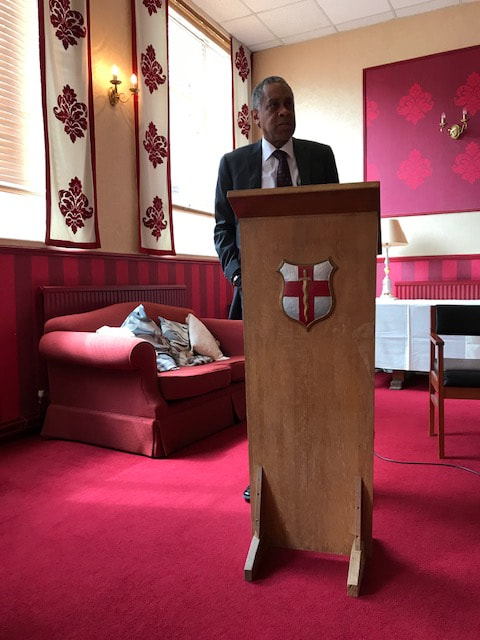
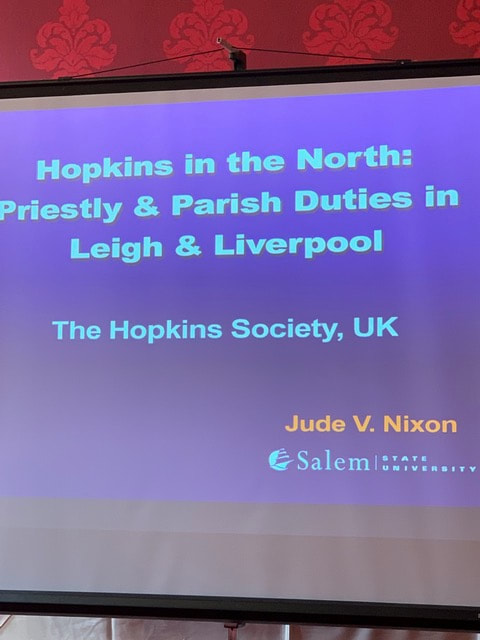
The AGM was followed by a most illuminating lecture by Jude Nixon who is co-editor of Volume 5 of the OUP’s Collected Works. Jude’s lecture was titled “Hopkins in the North: Priestly and Parish Activities in Leigh and Liverpool”. Jude provide the social and economic context to Hopkins position as priest. The congregation at Leigh, although friendly was experienced by Hopkins as largely drunken and dissolute with large families struggling with working long hours on low wages, and coping with ill health, particularly typhoid which has since been associated with unhealthy drinking water. The drinking water then was often replaced with copious amounts of beer. Few poems were written while Hopkins served in both parishes. Jude pointed out that this was probably as a result of the sheer amount of work involved amidst the misery of town life amongst the poor: he listed the number of weddings, baptisms and other parish duties that Hopkins undertook. This all took a toll on his health.

During Saturday afternoon, following a brief presentation of material relating to Hopkins and Belmont Abbey: the Benedictine’s place in the development of Hopkins religious vocation, the group had a tour of the abbey and a talk about it’s history in the Benedictine order. The founder was Francis Wegg-Prosser of nearby Belmont House, who had converted to Catholicism and decided to build a church on his Hereford estate in 1854. He later invited the Benedictines to found a priory there. The Abbey Church is a grade II listed building, designed by Edward Pugin, son of Augustus Pugin. Its construction began in 1857 and it was consecrated on 4 September 1860. Built in the early English style, it demonstrated the resurgent optimism of the restored Catholic Hierarchy and the growth in numbers of Roman Catholics in England in the second half of the 19th Century. .

During late Saturday afternoon, Richard Willmott, Chair of the Traherne Society was welcomed to provide a talk entitled “Seeing the world aright – charged with the grandeur of God”. Thomas Traherne, (1637 – 1674) was born in Hereford, spending most of his life in the vicinity. Like Hopkins he was on fire with the love of God, believing that God had created the world as a gift to humankind and that like Hopkins was a priest poet on fire with the love of God, especially as seen and experienced in the world created by God as a gift to each member of the human race. Richard opened up to his audience the poetry and the range of the writings of Thomas Traherne plus a little of his very positive theology. Throughout, his talk drew parallels with the work of Hopkins. The evening was completed with readings of Hopkins and Traherne on the subject of “God in creation” – showing that despite living some 200 years apart and in different religious worlds they held many of their theories and ideas in common. Hopkins would have been unaware of Traherne’s works’s; the latter’s works remained hidden in unread manuscripts until the 20th century.

During the entirety of our visit, members were given the opportunity to join in abbey services. As the Sunday was Whit Sunday, the church was beautifully decorated for the services, which frequently incuded Pentecostal elements. The Abbey church incidentally has always operated as the local parish church.

Sunday morning allowed participants either to attend mass or to take part in one of two walks, which Hopkins recorded his delight in. He is known to have walked to Belmont from Hereford along the river and also around the Cathedral Close. Members too enjoyed walking over the same ground, besides the River Wye, and the splendid views of Hereford Cathedral and its medieval architecture.
2018 Autumn Meeting at Mount St Mary’s College

The 2018 Hopkins Lecture was a most illuminating and thought provoking lecture on the similarities and differences between the works of Milton and Hopkins. The essence of the lecture being that Hopkins followed Milton’s style in writing sonnets using the Miltonian or Petrarchan form as against the Shakespearian or English form. But that towards the end of his life

Hopkins altered even the Miltonian form to his own purposes, thereby inventing a new sonnet form using sprung rhythm …. Lunch was followed by a tour of the college, visiting the nearby Spinkhill Catholic Parish Church with its beautiful millennial modern stained glass windows and also the sodality chapel (the oldest part of the building dating from the time the Roman Catholic Pole family built a chapel as part of the house following the reformation, in order that mass could still be celebrated in secret in the area.

The last session of the day featured a presentation by Jill Robson describing Hopkins time at the school, and extracts from letters home (ably read by Lore Chumbley), and the then industrial geography of the surrounding area, including Sheffield resulting in only one poem being written by Hopkins while at Spinkhill: “The Loss of the Eurydice”. Lance Pierson read this poem in the final session, along with a poem written after Spinkhill but inspired by two pupils there: “Brothers”, the latter reading being aided by society members in its reading.

Follow this link for more information about Mount St Mary’s college

2018 University of Roehampton Conference

June 21 to 23, 2018 – Conference at the University of Roehampton to celebrate the centenary of the first edition of Hopkins’ poems

An early email from Lesley Higgins to the secretary read that ‘The Hopkins Society presentation at the conference was excellent – informative, entertaining, and very spirited.  The dramatization of the letters was fascinating…’

One further snippet from Lance Pierson received Sept 19: ‘The conference to celebrate the centenary of Hopkins’ poems first being published was held appropriately at the college in Roehampton where he trained for the priesthood. Although this is in England, the conference was planned and administered from Regis University in Colorado. Sensing an opportunity, with the world on our doorstep, we asked for a table and display space to publicise ourselves and our wares as the UK Hopkins Society. A month before the conference I had an email from the Chairman, threatening to take away our space, as only 2 of our members had by then booked to attend. I pleaded with him and corrected his maths, and he relented; in the end 9 of our members made it. We managed to sell £70 of our merchandise: particularly popular was the colourful poster of the poem ‘Peace’, produced for the earlier centenary of GMH’s death. But I had to find cardboard packing tubes for people wanting to stow it in their luggage back to the States. Our pitch was well placed at the foot of the stairs up to the main meeting room. I stuck a large card announcing UK Hopkins Society on the side of the staircase, and promptly got into more trouble. The college archivist / historian gave us a guided tour of the historic building. When we came to the stairs she shrieked, ‘WHO has polluted the beautiful iron railing with bluetack?!’  Only on promise of washing all traces of it off did I calm her down!’

A further review was received from Pat Pinsent, Senior Research Fellow in English, Roehampton University: ‘This conference, held in a location where Hopkins spent some of his formative period as a Jesuit, brought together academics and enthusiasts for his poetry from both sides of the Atlantic. After the official welcome, the first session was about the website recently set up by the International Hopkins Association (based in Chicago in the USA), which revealed that Hopkins now has 1000 followers on their Facebook link – what would he have thought about that? This was followed by a presentation from the editors of several volumes of the scholarly edition (OUP) of his Collected Works which will be completed by 2020. This will include the journals, commonplace books, notes for lectures, sketches, musical ideas, plus information about his many uncompleted projects, such as a book on Homer.
Plenary sessions included the centenary lecture by Joseph Feeney SJ, transmitted from the States, and an illustrated account from Professor Kirstie Blair about how Hopkins’ fascination with poetic structure was accompanied with an appreciation of the bold engineering projects which characterised the period. Seminar papers covered a wide range of topics, including theology, philosophy, literature, numerology, philology, architecture, and medieval music. A conference highlight was a dramatised presentation by members of the UK Hopkins Society of letters discovered in the archives of Highgate School, focusing on the period of his conversion to Catholicism and the sadness this event occasioned to his devotedly Anglican parents. Altogether this was a most rewarding three days, enhanced by the knowledge that Hopkins himself had trodden these corridors and seen the lovely views over Richmond Park.’

2018 St Bueno’s Visit

Hopkins Society members enjoying the St Buenos gardens on the study day

“Nothing is so beautiful as Spring” … On Saturday April 7 2018, some 16 members 
of the society visited St Bueno’s Jesuit Spirituality Centre. Hopkins lived here from 1874 to 1877, studying theology in preparation for the priesthood. These were some of his happiest years and he wrote some very inspirational poetry here with God and the welsh language and scenery as the background. Indeed it was here that the rector at the time inspired Hopkins to start writing poetry again, after a self imposed ban to better concentrate on his vocation, when the rector commented that someone ought to write a poem based on the wreck of the Deutchland ship in 1975.
The first session on “Preparing to read the poems aloud” was led first by Wyn Hobson and we looked at “Thou are indeed just, Lord”, a poem in iambic pentameter form with five stressed syllables in each line.  Unlike later poems, this poem is not written in sprung rhythm, a form invented by Hopkins. Wyn helped us to work our way through unstressed and stressed syllables, even finding some that are only half stressed. Lance Pierson took up the mantle and the group analysed the poems of “Spring” and “Hurrahing in Harvest”, remembering that Hopkins in his letters to Robert Bridges stressed that his poems worked best when read aloud, and he often included stress marks on his poems. Lance finished by reading “Spelt From Sybil’s Leaves, a poem that even many Hopkins enthusiasts find difficult to read and understand but which became all the clearer with the notes that Lance provided and his reading of it, in the way Lance interpreted that Hopkins intended …..
  The group experienced an excellent contemplative silent lunch amongst the current retreatants, but due to the misty, drizzly weather and the very muddy state of the local footpaths, the planned guided walk around Moel Maenefa and the welsh countryside that Hopkins so loved was postponed and the group had a walk in the grounds of St Bueno’s instead.  (photograph below) …In summary the members left inspired to better read Hopkins poetry aloud in future …

2017 Hopkins Society Day

Hopkins Society Day exploring the origins of Gerard Manley Hopkins and of his most famous poem ‘The Wreck of the Deutschland.’ Hopkins was born in Stratford (Essex, not upon Avon!) in 1844. In addition to the Society’s AGM, we visited the sites of his childhood home and church, and heard about the members of his family. By a strange coincidence the nuns drowned in the German ship ‘Deutschland’, about whom he wrote in his most famous poem, were brought to rest in Stratford and are buried in neighbouring Leytonstone. We visited their graves.